by melinda
Share
The steel frame of container houses is a standardized frame structure made from high-strength steel through a series of precise processes such as cutting, welding, grinding, and anti-corrosion treatment. It serves as the "skeleton" of container houses. Compared with the concrete frames of traditional buildings, it has unique advantages in material properties and structural design. It not only continues the sturdiness and durability of steel but also conforms to the modular design concept of containers, achieving a dual breakthrough in practicality and economy.


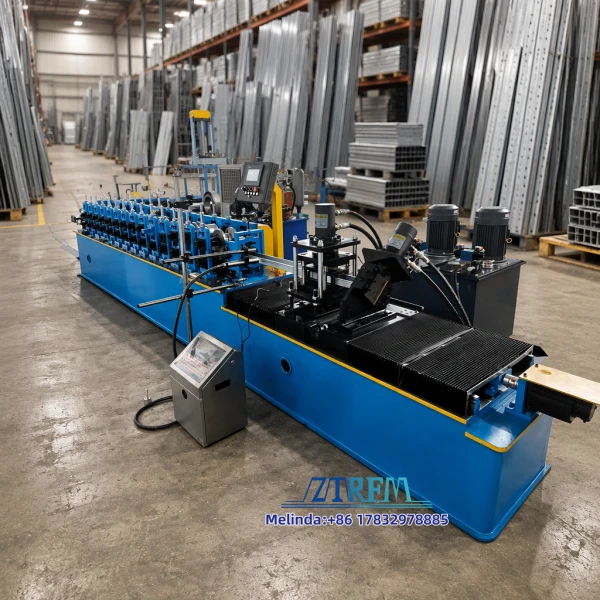
This container house steel frame making machine is made for an Algerian client, who bought a total of 4 sets of roll forming machines. It includes 2 sets of container house frame machines.
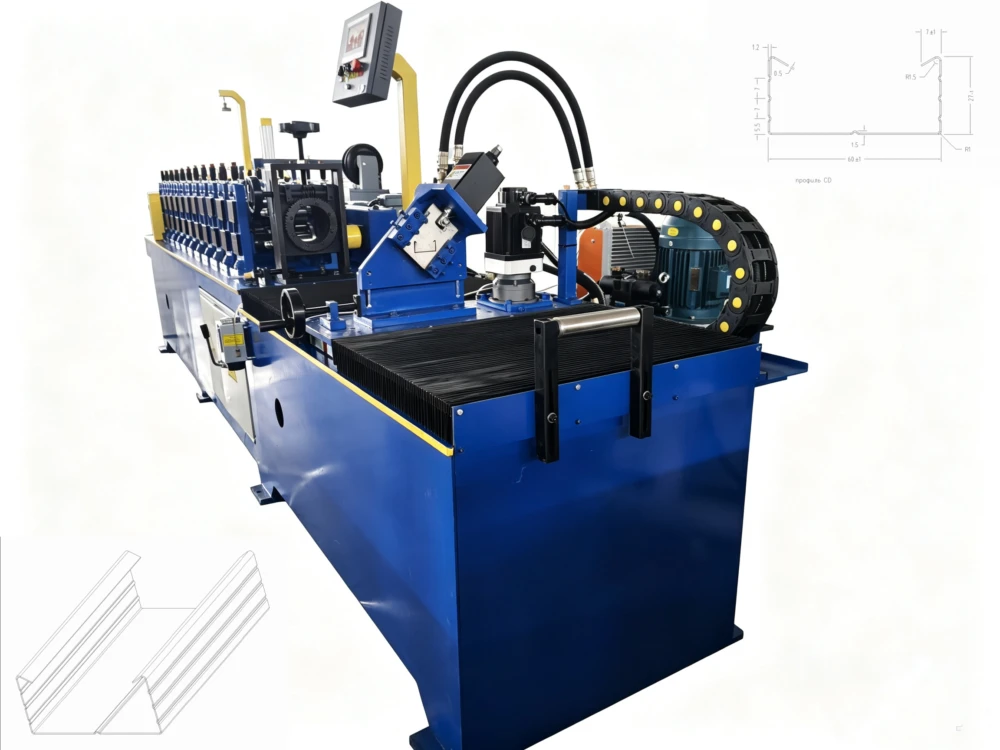
The profile drawing of the container house steel frame is shown below:


The main technical specifications of the container house steel frame machinery
- rolling stations: 18-20 rolling stations
- The shaft material is high-quality C45 steel, with tempering treatment.
- The roller material is GCr15 steel, with quenched treatment, HRC58-60
- Transmission by gearbox, it is more powerful.
- The machine structure is a cast steel arch structure, with a thickness of 35mm.
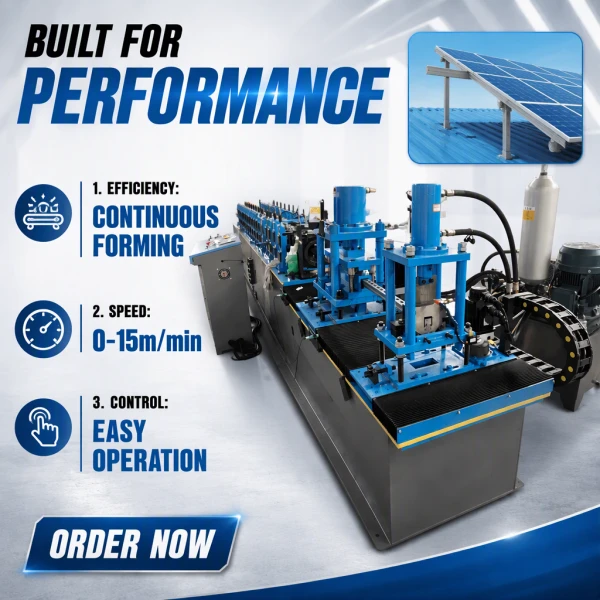
- Machine run speed:0-15m/min
- The main motor power: 22KW
- Cutting type: Hydraulic cutting, cutting blade material Cr12 steel, quenched treatment, HRC58-60


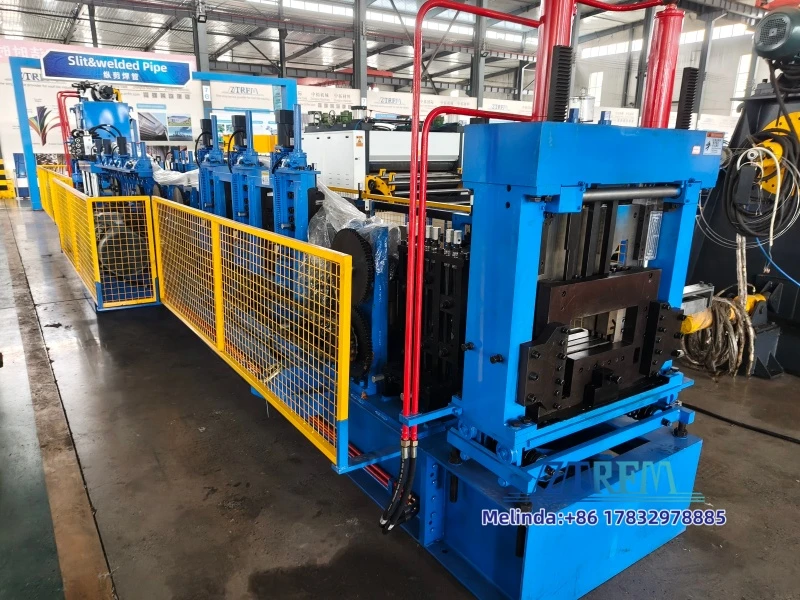
After the steel sheet goes through the feeding device and leveling rollers, it will be punched with square holes in the flat sheet.

There are a total of 7 leveling rollers, up 3+down 4. It makes sure that the steel plate is very flat before punching.
The advantage of the Cangzhou Zhongtuo Container house steel frame making machine:
- It features high forming accuracy and strong stability, meeting the requirements of steel frame structures. This equipment adopts a continuous rolling processing technology with multiple sets of upper and lower roller forming molds. Relying on the precise control of the numerical control PLC panel, it can gradually roll steel into the shape that meets the requirements of container steel frames. The forming error can be controlled within a very small range, which is far superior to traditional processing methods. It can effectively ensure the dimensional consistency of key components such as corner columns and side beams of the steel frame. To avoid deviations in subsequent splicing and welding, the core components of the equipment are made of high-strength alloy materials. The roller shafts undergo quenching and fine grinding treatment, which makes them less prone to wear during long-term operation, further ensuring the stability of the forming accuracy and meeting the processing requirements of high-strength carbon steels such as Q235 and Q355.
- It features high production efficiency and low energy consumption, reducing the cost of large-scale production. Rolling forming adopts a continuous processing mode, without the need to interrupt operations. The production speed can reach 8-10 meters per minute. Some high-efficiency models can produce 300-700 meters of light steel structure components per hour, which is significantly more efficient than the traditional step-by-step processing of cutting and bending. It can quickly meet the batch production requirements of container steel frames. Meanwhile, the equipment adopts cold-bending and rolling technology, which does not require high-temperature heating. The motor power is reasonable, and the energy consumption is much lower than that of flame cutting and thermal processing methods. Moreover, there is no excessive waste of scraps during the processing, and the material utilization rate is greatly improved. Long-term use can significantly reduce the energy consumption and raw material costs of enterprises and increase production profits.
3. It features a high degree of automation and convenient operation, reducing reliance on manual labor. The equipment integrates the full-process functions such as uncoiling, leveling, rolling forming, fixed-length cutting, and material collection. It adopts professional industrial computer CNC automatic control. The processing size and batch quantity can be set through the touch screen to achieve automated continuous operation. Only a small number of workers are needed to complete simple operations such as material loading and inspection. It can be operated without professional technical workers, which not only reduces the input of labor costs It also avoids the errors caused by manual operation, significantly enhancing production stability. Meanwhile, it is equipped with an encoder counting function, which can precisely control the quantity and length of finished products, facilitating production management.
4. It has wide adaptability and strong customization capabilities, meeting diverse needs. This equipment can flexibly adjust the rolling die and processing parameters. It can not only process various components of conventional specification container steel frames, such as 20-foot and 40-foot, but also produce special-shaped components of different cross-sections and sizes according to customer customization requirements, meeting the personalized design needs of container houses in different scenarios, such as culture and tourism, emergency response, and office work. Some manufacturers can also customize exclusive molds and equipment configurations based on the specific processing requirements of customers, adapting to the processing of plates of different thicknesses ranging from 2 to 3mm. This enables multi-category production without the need to replace the entire set of equipment, thereby enhancing equipment utilization and production flexibility.