Whether you supply materials or run a purlin factory, you might wonder about C and Z purlins. What is the difference? Which one should you stock? You worry about picking the wrong type and losing sales. You also worry about buying extra equipment and tying up money in inventory. We understand your concerns.
Our z and c purlin machine has 13 interchangeable units, so one machine produces both C and Z purlins. You don't need to struggle with the choice or worry about stocking the wrong profile. The rollers are custom made to your drawings, and you decide which profile to run.

Z and C purlin machine
What is the difference between C and Z purlins?
Before we talk about equipment, let us clarify the differences. C and Z profiles differ in cross section shape, load performance, and suitable applications. Here are three angles to help you understand.
Structural differences
C sections have a 90 degree angle with lips bent inward. Z sections have an angle less than 90 degrees, with flanges facing opposite directions. This angle difference affects how they perform on sloped roofs. Z sections make better use of bending resistance on steeper slopes.
Z purlins twist less under wind uplift and typically carry more load than C purlins of the same size. In areas with high wind loads, this advantage stands out.

C PURLIN Pattern drawing

Z PURLIN Pattern drawing
Application scenarios
-
C purlins: work well on buildings with gentle roof slopes, wall girts, and wall beams
-
C purlins: used for light roof trusses, brackets, columns, and beams in mechanical fabrication
-
Z purlins: suit factory and industrial buildings with steeper roof slopes
-
Z purlins: ideal for long span structures and continuous purlin designs
-
Z purlins: good for roof systems in high wind load areas
-
Both profiles: used in industrial plants, warehouses, solar mounting systems, and agricultural greenhouses

The application of c z purlin
Lap joints and load transfer
C purlins connect to the frame with bolted hinges and are calculated as simply supported beams. Z purlins can form rigid connections through overlapping joints and are calculated as continuous beams. Continuous members handle greater loads and more deflection.
The lap joint style directly affects structural performance. Z purlins lap more easily and work well as continuous members. For long span roofs, Z purlins are the smarter choice.
Now that you understand the differences between C and Z, let us see how our equipment solves your selection and stocking challenges.

The finished product of c purlin

The finished product of z purlin
One machine produces both purlin types
C and Z each have their strengths, but buying two machines costs more and takes up floor space. Our z and c purlin machine comes with 13 interchangeable units, and flipping them 180 degrees switches between C and Z shapes. One machine covers both profile types.
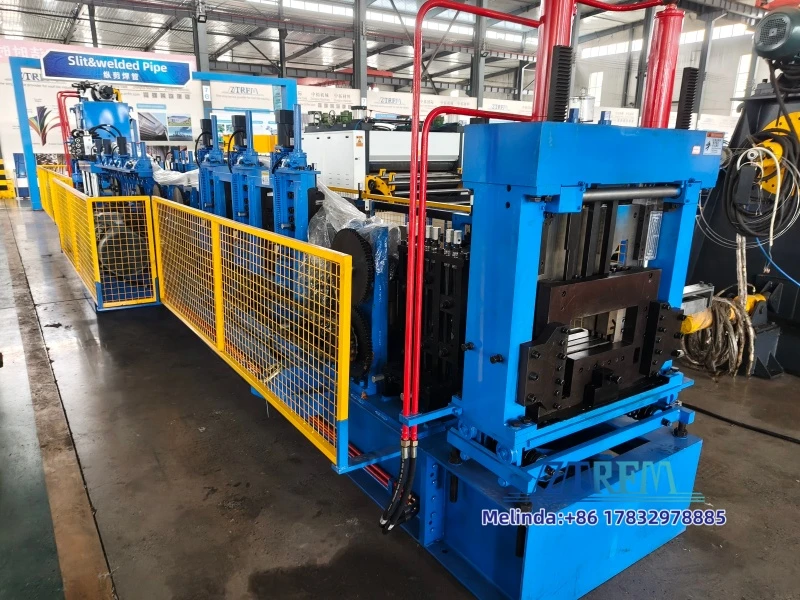
The machine uses 18 forming stands. Rollers are Cr12 steel, quenched to HRC 58-62. Shafts are 40Cr solid steel, tempered to HRC 28-32. The arch type rack ensures stable operation over the long term. A servo motor drives the double chain transmission. An encoder measures length automatically, and length tolerance stays within 300mm-1.0mm.

hydraulic decoiler

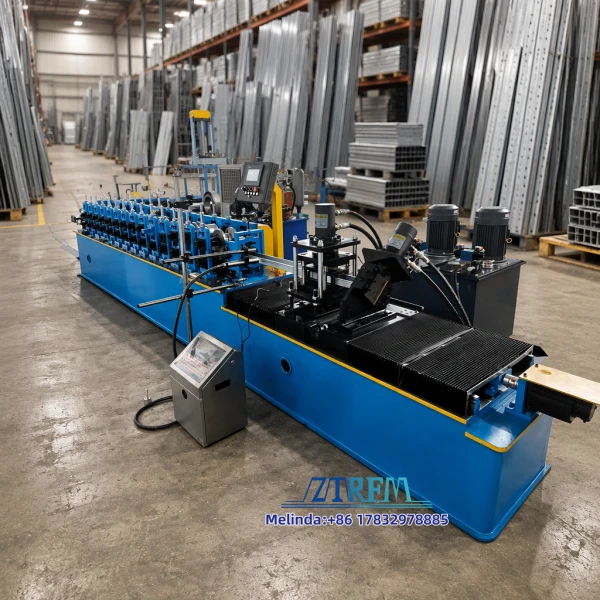
The forming part of the c z purlin interchangeable roll forming machine

The stamping part of the c z purlin interchangeable roll forming machine
Technical specifications
| Component | Item | Specification |
|---|---|---|
| Pre punching and pre cutting | Punching units | 2 sets |
| Punching needle and die material | Cr12MoV | |
| Punching needle and die hardness | HRC 58-62 | |
| Pre cutting blade material | Cr12MoV | |
| Pre cutting blade hardness | HRC 58-62 | |
| Main forming machine | Forming stands | 18 stands |
| Adjustable flange stand | 1 stand, 87°-95° adjustment | |
| Interchangeable units | 13 sets, flip 180° to switch | |
| Shaft diameter | φ88mm-70mm | |
| Roller material | Cr12 | |
| Roller processing | CNC machined, quenched HRC 58-62, precision finished | |
| Shaft material | 40Cr | |
| Shaft type | Solid shaft | |
| Shaft processing | CNC machined, tempered HRC 28-32, precision finished, electroplated | |
| Rack structure | Arch type | |
| Transmission | Double chain | |
| Drive motor | Servo motor, 2.2kW | |
| Straightening units | 2 sets | |
| Post cutting | Cutting type | Hydraulic, stepless adjustment |
| Blade material | Cr12MoV | |
| Blade hardness | HRC 58-62 | |
| Length measurement | Automatic encoder | |
| Length tolerance | 300mm-1.0mm | |
| Hydraulic station | Motor power | 18kW |
| Tank capacity | 800L | |
| Cooling | Cooling fan | |
| Solenoid valve brand | YUCI-YUKEN / HUADE | |
| Control system | Operation interface | Laptop |
| PLC brand | Xinjie | |
| Proximity switch brand | Autonics (Korea) | |
| Counter brand | Omron / Controlway | |
| Language | English / Chinese | |
| Data input | Manual screen entry / USB import / QR code transfer | |
| Automatic stacker | Suitable purlin length | ≤12m |
| Conveying method | Motor conveyor | |
| Stacking method | Electromagnet |
Selection guide
Projects with gentle roof slopes work fine with C purlins. Steeper slopes call for Z purlins, as they offer better bending performance. For wall applications, either type performs similarly. Long span roofs lean toward Z purlins. High wind load areas favor Z purlins for their higher load capacity.
When you need to produce both profiles, a CZ interchangeable machine makes more sense than two separate machines. One unit takes less floor space, costs less, and changes over in just 5 minutes.

The cutting section of the c z purlin interchangeable roll forming machine
You probably started this search worrying about picking the wrong profile for your projects, or about buying an extra machine you might not fully use. Whatever your concern, we can tailor a solution to your specific working conditions. Send us your drawings and requirements, and we'll handle the rest.
We help you put both purlin profiles on one machine.