You install downpipes, a heavy rain comes, and then you see it: poor connections, uneven shapes, or noticeable differences between batches. If a rain water downspout roll forming machine can't maintain consistent dimensions during forming, these problems are likely to keep coming back.
So if issues only show up at the installation stage, should manufacturers look further back, at the production process? The equipment used for forming downpipes and how stable it runs are factors worth paying attention to.
A downpipe's performance depends on installation, sure. But it also depends on the shape, size, and consistency of the pipe itself.
Applications of Downpipes in Different Building Types
Downpipes are used across nearly every building type that needs a proper drainage system.
-
Residential buildings: houses and apartments
-
Commercial buildings: shops and office blocks
-
Industrial buildings: warehouses and factories
-
Public buildings: schools and hospitals
-
Renovation projects: replacing old systems while keeping building appearance
Different projects ask for different things from the pipe, such as cross section shape and dimensions, which means the production equipment needs to handle these requirements consistently.

The application of downspouts
What Affects Downpipe Performance
Installation quality matters, but it's not the only thing that counts. The pipe's shape accuracy, dimensional consistency, and wall thickness uniformity are just as important.
Cross section deviations cause poor connections. Size fluctuations affect how well multiple sections align and seal. These problems trace back to the production stage, not just the installation.
Advantages:
-
Stable roll forming keeps product dimensions consistent across long production runs
-
Continuous forming delivers high repeatability between batches
-
Automatic hydraulic cutting removes the risk of manual measurement errors
-
Speed adjustment lets manufacturers adapt to different materials and order sizes

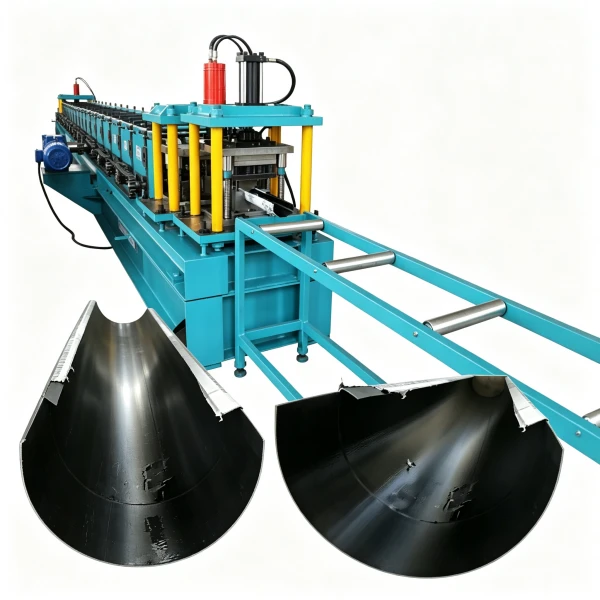
Rain Water Downspout Roll Forming Machine - Feeding and Forming Section

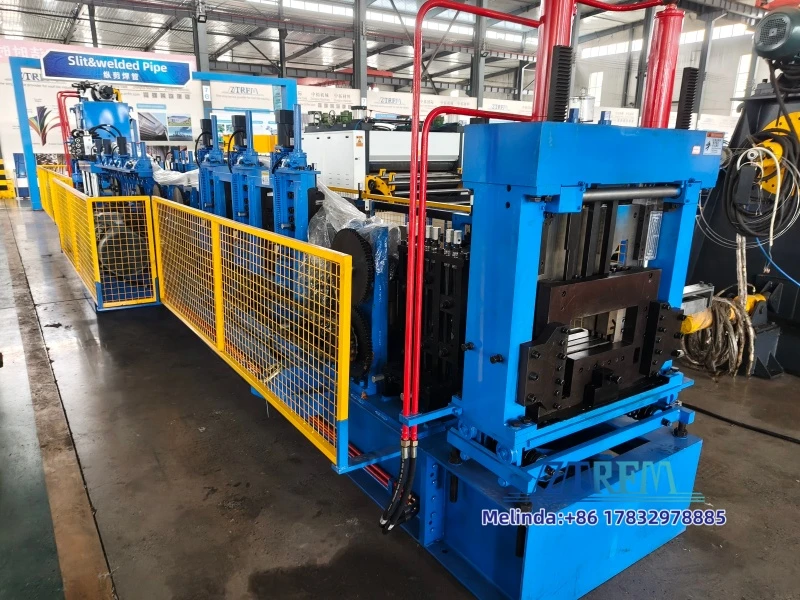
Rainwater Downspout Roll Forming Machine - With Guard NetRainwater Downspout Roll Forming Machine - With Guard Net
How Downpipe Shape and Size Are Formed
Making downpipes means gradually shaping metal coil into the required cross section. The coil enters the equipment, passes through a series of roller stations, and bends step by step. The result is a continuous pipe with a consistent cross section, cut to length as it exits.
Each roller station adds only a small amount of deformation. After several stations, the final shape emerges. Three factors directly decide product quality here:
-
Roller accuracy: small errors add up and affect the final cross section
-
Material flow: affects how evenly wall thickness stays distributed
-
Forming stability: determines whether the whole coil produces uniform pipes

Rainwater Downspout Rolling Forming Machine - Forming Section

Rain Water Downspout Roll Forming Machine - Roll Details
The Equipment Role in Maintaining Consistency
Good product consistency relies on stable control throughout production. The machine's structure keeps roller positions stable during forming. Any shift in roller position will show up in the finished pipe. Drive system stability affects speed uniformity across the whole coil.
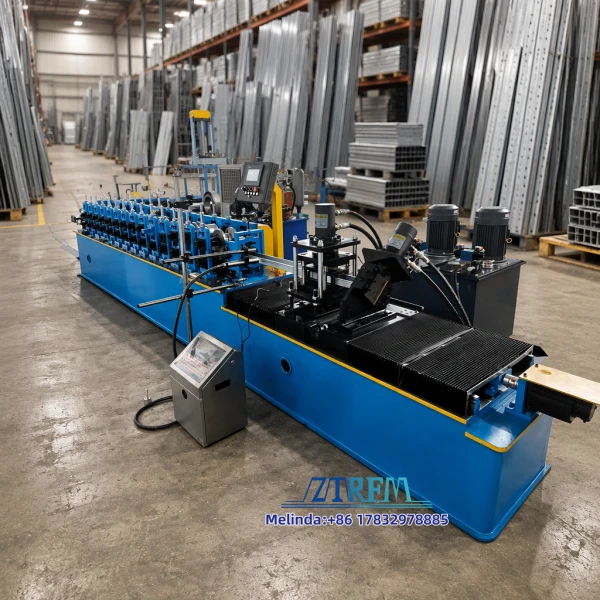
A down pipe making machine is built for this continuous production process. The full process is straightforward: uncoil the metal, feed it into the forming section, pass it through the roller stations, cut it to length, and discharge the finished product. This is where the rain water downspout roll forming machine provides its value: not just bending metal, but supporting consistent output.

Rainwater Downspout Roll Forming Machine - Cutting Section
Key Features and Parameters
Parameters:
| Item | Information |
|---|---|
| Motor brand | Siemens |
| Electrical brand | Delta, Omron, Schneider |
| Cutting type | Automatic Hydraulic Cutting |
| Speed range | 0-20 m/min |
| Material thickness | 0.3-0.8 mm |
| Machine weight | 5000 kg |
| Factory testing | Machinery Test Report, Video outgoing inspection |
| Other information | Customizable |
Advantages:
-
Siemens motor with reliable electrical controls supports stable operation
-
Hydraulic cutting ensures accurate lengths for easier installation
-
Speed range fits different production rhythms
-
Machine weight reflects the frame construction needed for forming rigidity

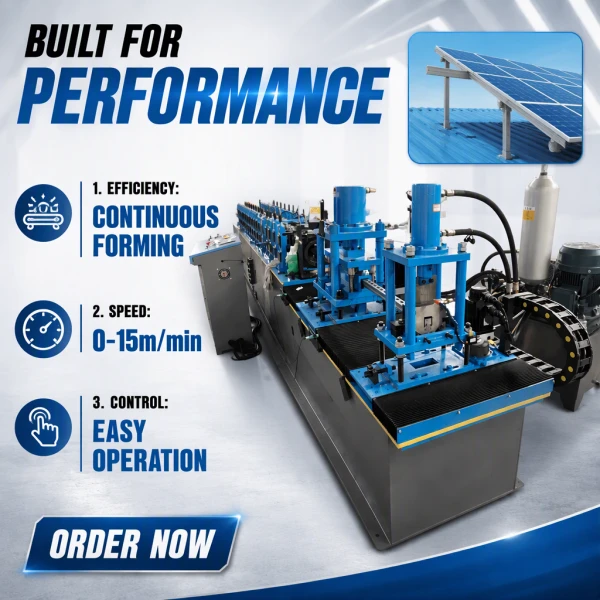
Rain Water Downspout Roll Forming Machine - Control Panel and Frame

Rainwater Downspout Roll Forming Machine - Side View
Back to the original problem: why should consistent downpipe production start with the forming process?
The answer is straightforward. A downpipe's job is to drain water away from a building. Its performance depends not only on installation, but on consistent product quality. That quality has to be built in during production, not just checked afterward.
For downpipe manufacturers, the forming process is one of the foundations for getting consistent products. The rain water downspout roll forming machine helps provide that foundation, not as a standalone solution, but as part of a production process where stability and consistency matter.