by melinda
Share
Many fencing manufacturers know this struggle all too well: you get large orders, but your manual production just can't keep up, so you have to turn them down. With manual or semimanual methods, workers have to cut, punch, and bend each piece by hand. It's slow, and every batch comes out a little different in size and angle. Customers notice, and they ask for rework or refunds.
The Full Automatic Fence Panel Roll Forming Machine brings uncoiling, roll forming, punching, and cutting together into one continuous line. From the moment the steel coil enters the machine to the moment the finished fence panel comes out, the whole process runs automatically. This article walks you through the machine's core technology, typical applications, and customization options.

Full Automatic Fence Panel Roll Forming Machine
Applications
Fence panels produced by this equipment are widely used in:
-
residential boundary fencing and garden decorative fencing
-
security fencing around industrial parks and commercial facilities
-
highway and expressway guardrails
-
agricultural fencing for farms and livestock facilities
-
temporary construction site barriers
-
landscape fencing for parks and public spaces

Finished Fence Panel1

Finished Fence Panel2
Core Components
Machine Frame
The first thing you notice about this machine is how solid it feels. Its frame uses welded steel construction with H beam steel base plates that measure 16 to 22 millimeters thick. Knock on it, and you hear a deep, solid sound, nothing like the hollow ring of a flimsy machine.
When the machine runs at high speed, the forming rollers keep pushing against the steel strip, sending shock loads through the frame. A heavy, rigid frame absorbs those loads and keeps every roller station locked in position. That's why the Full Automatic Fence Panel Roll Forming Machine stays reliable through 24/7 production. Your operators won't have to keep stopping to check if anything has shifted.

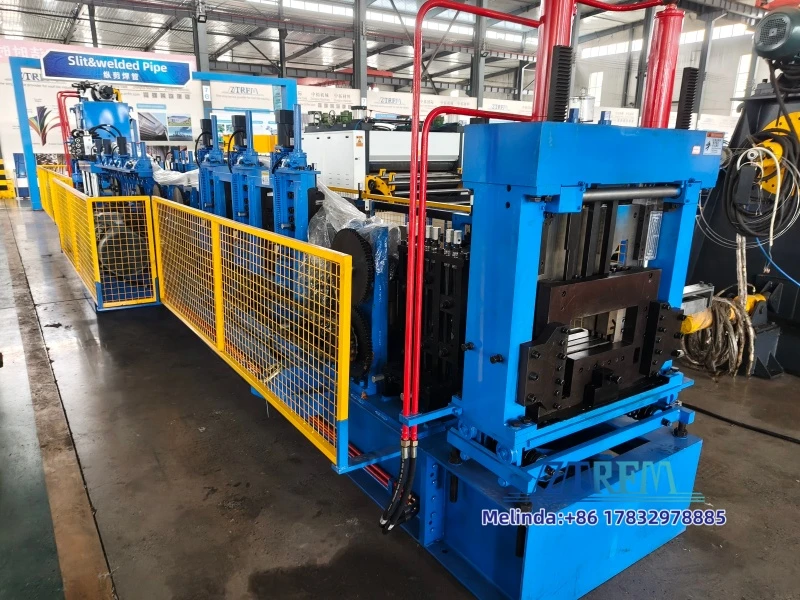
Full Automatic Fence Panel Roll Forming Machine Frame
Roller System
Think of the forming rollers as the machine's teeth. Their material and surface treatment decide the quality of your finished fence panels. The rollers use GCr15 bearing steel or Cr12 die steel, through hardened to HRC58 to 62, which puts them in the same hardness range as cutting tools.
After hardening, the rollers get a hard chrome plating. This gives them a smooth, hard surface that reduces friction as the steel strip passes through and resists scratching. With this hardness, the rollers hold their shape through years of use. The fence panel you make at batch number ten thousand will have the same cross section as batch number one hundred thousand. And longer roller life means fewer replacements and lower maintenance costs.

Full Automatic Fence Panel Roll Forming Machine Roller System
Control System
The machine runs on a PLC based control system with a touchscreen interface that's straightforward and easy to read. Your operator just types in the panel length, quantity, and hole positions, and the machine handles the rest.
The system also saves order parameters. For the fence styles you make most often, you can store the complete forming recipe in the memory. When a repeat order comes in, the operator calls up that recipe with one touch and production starts right away, no need to enter every setting again. The PLC works with rotary encoders to keep track of length and position in real time, so every finished panel comes out to your specified dimensions.

The feed port of the Fence Panel Roll Forming Machine
Forming Process
This equipment uses continuous cold roll forming. The steel coil feeds through an uncoiler, then passes through leveling, punching, multistage roll forming, and hydraulic cutting. The forming section usually has 14 to 22 roller stations, each one adding a small bend, gradually shaping the flat strip into the target profile.
This gradual approach lets the metal flow slowly into shape at room temperature. It avoids surface cracks or excessive spring back that you'd get from a single sharp bend. And since cold forming doesn't require heating, it saves energy and keeps the galvanized or prepainted coating intact. That means your fence panels stay rust resistant for years outdoors.

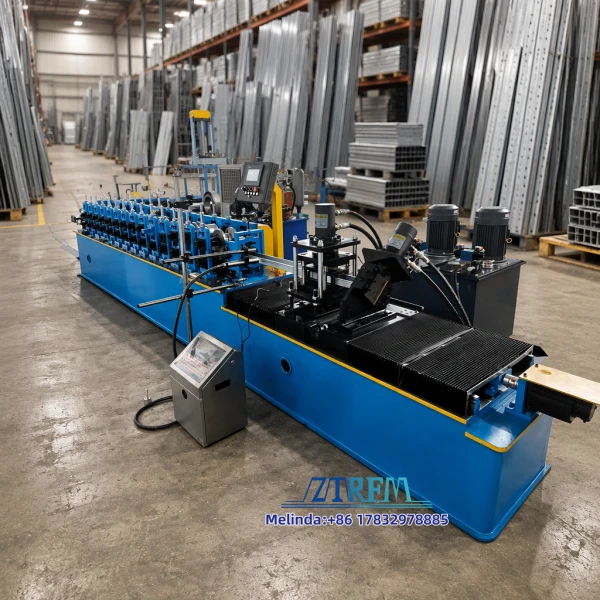
The entire production line of the Fully Automatic Fence Panel Roll Forming Machine
Cutting
The Full Automatic Fence Panel Roll Forming Machine comes with a hydraulic cutting system and punching units. The cutting blades use Cr12 die steel, so they stay sharp and hold up well under heavy use. The hydraulic system delivers steady cutting force, and with the length measuring device, it cuts each panel to the preset length automatically.
Finished panels have clean, burr free cut ends. Your installation crew can just fit the panels in place without any extra filing.

The cutting section of the Fence Panel Roll Forming Machine
Business Value
So what does this equipment actually do for your business?
-
Production speed jumps up. The machine runs at 10 to 30 meters per minute. One machine with one or two operators can put out what used to take five or six people on a manual line. So labor cost comes down noticeably.
-
Product quality stays consistent. Automated forming takes human error out of the equation. Every batch comes out the same in length, profile, and surface finish. Fewer customer complaints, fewer rework requests.
-
Delivery reliability improves. The PLC system supports continuous production. When a big order comes in, you can promise a delivery date with confidence instead of worrying whether you can produce enough in time.
Add these up, and you get one clear outcome: you can take orders you used to turn down and compete in markets you couldn't reach before.

Hydraulic shearing
Selection Guide
When you're choosing a Full Automatic Fence Panel Roll Forming Machine, start by answering three questions about your needs.
-
What raw material will you use? Determine the thickness range, width, and material type, galvanized steel or prepainted steel, for example. Different materials affect roller wear differently, which guides the roller material selection and treatment.
-
What finished product do you want to make? Define the fence profile, height range, and the positions and sizes of mounting holes. These specs determine the roller tooling design and the punching unit configuration.
-
How much do you plan to produce per month? Estimate average daily or monthly output. This tells you what forming speed and automation level you need. Higher production targets require stronger continuous run capability and more automation.
Share your answers to these three questions with the equipment supplier, and they'll give you a tailored solution and a quote. If you're working on a new fence profile design, you can also discuss custom roller tooling.

Details presentation
Customization
The machine offers flexible customization to match your production needs. For the electrical system, you can choose from PLC brands like Siemens, Delta, or Mitsubishi, and the voltage can be set to 380V, 415V, 480V, or other standards.
For the mechanical side, the roller tooling gets machined specifically for your fence profile. The shaft diameter and number of stations are adjusted based on material thickness and forming complexity. The machine's paint color can also be customized to match your factory or brand identity. This flexibility lets the same machine model adapt to different countries and different market positions, whether you're targeting economy or premium segments.

Fence Panel Roll Forming Machine Overall presentation
Service Support
Before shipment, the supplier provides video inspection and a mechanical test report, so you can confirm the machine's condition from your office. After it arrives, the supplier offers installation guidance and operator training to get your team up to speed.
During the warranty period, nonhuman fault parts get replaced free of charge. If you run into issues during production, you can reach technical support online anytime. For overseas customers, some suppliers can also send engineers on site for installation and production ramp up. The whole point is simple: get your machine running and making money, not sitting on the shop floor.
Whether you're planning a new fencing production line or upgrading existing equipment, we'd like to hear about your needs and offer practical suggestions. Feel free to contact our sales team for full specs and a quote.
whatsapp/wechat: +8617832978885
Email:[email protected]